

Traditional Montessori floor beds are often made from wood, offering a classic look and lasting durability. But during the early months, when little ones are still developing spatial awareness, safety and comfort can be just as important. From restless nights to inevitable tumbles, children may bump into the bed frame while crawling, playing, or moving around half-asleep.
Choosing between an all-foam bed and a wooden Montessori floor bed comes down to balancing safety and convenience with style and ventilation. All-foam toddlers beds provide a soft landing with no hard edges, while wooden frames offer a more traditional look, better airflow beneath the mattress, and clearly defined sleeping boundaries.
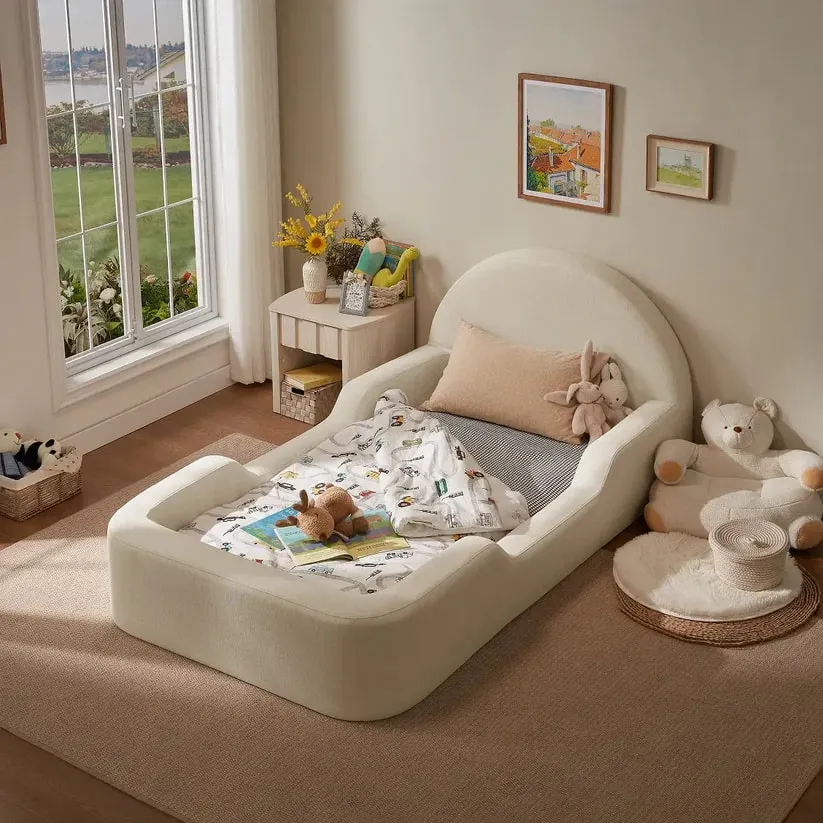
What Are Montessori Foam Floor Beds?
Montessori floor beds are low-profile beds designed to give children greater independence and freedom during sleep. Unlike traditional beds, their low height allows children to get in and out more easily on their own.
Some families place the mattress directly on the floor, while others choose a low frame that provides space underneath for better ventilation. Floor beds can be designed for infants and toddlers, or sized for shared use depending on the child’s needs and the family’s setup.
All-Foam Floor Beds: Pros and Limitations
-
Soft & Safe: No hard corners, wooden slats, or rigid frames to bump into during nighttime movement.
-
No Entrapment Gaps: The all-foam design eliminates gaps between the mattress and a rigid bed frame.
-
Easy to Maintain: Lightweight and portable, with many designs featuring removable, machine-washable covers.
-
Limited Ventilation: Foam can retain body heat, and when placed directly on the floor, the mattress has limited airflow underneath. Proper ventilation and moisture management are important.
What Is a Wood Floor Bed?
A wood floor bed is a low-profile wooden bed frame designed to keep the mattress close to the floor, typically just a few inches above ground level. It usually features a slatted or solid base that supports the mattress without a traditional box spring.
Wood floor beds are especially popular for:
-
Toddlers transitioning from a crib: A low sleeping surface makes getting in and out easier.
-
Montessori-style bedrooms: The design encourages independence and freedom of movement.
-
Small spaces: The simple, low-profile design takes up less visual space.
-
Natural, minimalist interiors: Wood adds a warm, timeless look to a child’s room.
Traditional Wood Floor Bed: Pros and Limitations
What Wood Does Well
-
Strong visual presence: A pine or birch house frame can become a beautiful focal point in a child’s room.
-
Decorative potential: The roof-style frame can be decorated with fairy lights, canopies, or garlands.
-
Long-lasting: A well-built solid-wood frame can last through multiple children.
Where Wood Floor Beds Fall Short
-
Hard edges and corners: Rigid frames, slats, and joints can be uncomfortable when toddlers roll, climb, or move around at night.
-
More assembly: Many wooden house beds require multiple parts and several hours of assembly.
-
Mattress fit matters: The mattress must fit the frame securely to avoid dangerous gaps.
-
Heavy and less portable: Wooden frames can be difficult to move or rearrange.
-
Material emissions: Engineered wood such as MDF or particleboard may emit VOCs, while paints and finishes can also contribute to off-gassing.
Foam Floor Beds: A Different Approach
A foam floor bed takes the core Montessori principles—floor-level access, independence, and freedom of movement—and combines them into a simple, one-piece design. The bed itself is made from high-density foam with a removable, washable fabric cover and sits directly on the floor.
You lose the peaked roof and wooden frame, but gain:
-
No hard edges: Soft foam surrounds the sleeping space, with no rigid corners, joints, or hardware.
-
No assembly: Simply unpack, place it on the floor, and it’s ready to use.
-
No mattress-to-frame gap: Because the mattress and bed are integrated, there is no gap between separate components.
-
Lightweight & portable: Many foam designs are light enough for one parent to move between rooms.
-
Easy to clean: Removable, machine-washable covers make everyday maintenance easier.
Safety Comparison
|
Safety Factor |
Wood House Bed |
Foam Floor Bed |
|
Hard edges/corners |
Yes |
None |
|
Mattress-to-frame gaps |
Possible |
None with integrated design |
|
Tip-over risk |
Low, but possible |
Minimal |
|
Climbing hazards |
Possible |
No rigid structure |
|
Hardware maintenance |
Requires periodic checks |
No hardware |
|
Materials/certifications |
Varies by product |
Varies by product; look for applicable certifications |
Who Should Choose a Wood House Bed?
A traditional wood house bed may be a good fit if:
-
Your child is 3+ and more confident moving around their sleep space.
-
Style and decoration are a top priority.
-
You already have a well-fitting, high-quality mattress.
-
You’re comfortable with regular hardware and gap checks.
Who Should Consider a Foam Floor Bed?
A foam floor bed may be a better choice if:
-
Your child is still developing coordination and spatial awareness.
-
Soft edges and a simple design are your priorities.
-
You want zero assembly and a ready-to-use bed.
-
You need something lightweight and portable.
-
Removable, washable covers are important for everyday use.
Compression Sofas China Source Factory – KINGSEN Foam
KINGSEN is a professional manufacturer with over 20 years of experience in designing and producing high density foam products and compression sofas. the main prodcuts include: Modular Sectional Sofas, Sofa Beds, Bean Bag, Kids Couch & Climbing Play .etc. We supply full custom service, including developing OEM & ODM projects. all products can be customized by material, size, color, logo, and more. Our company owns 55000m2 factory area and more than 200 sets of advanced manufacturing equipments, Perfect and rigorous QC system. Also, we have passed the ISO9001: 2015, BSCI, IAF Quality Management System Certification. We look forward to your visit and the opportunity to build a successful partnership together.
More details: https://www.kingsenfoam.com/